> For the complete documentation index, see [llms.txt](https://docs.shipscout.app/llms.txt). Markdown versions of documentation pages are available by appending `.md` to page URLs; this page is available as [Markdown](https://docs.shipscout.app/tasks/bring-your-own-targeting-platform.md).
# Bring your own targeting platform
You can use your own targeting/experimentation platform to determine which test variant your visitors should be in. This guide will walk you through setting this up.
{% hint style="warning" %}
Requires engineering work
{% endhint %}
### Why would I want this?
Many of our merchants use a generalized A/B test platform for non-shipping rate experiments. This feature allows you to utilize the power of ShipScout's shipping rate configurability with your own existing targeting tool.
### Step 1 - Set up your test
Create a ShipScout test as you normally would. BYOTP is available to all types of tests: threshold, flat rate and custom.
### Step 2 - Enable "Use your own targeting platform"
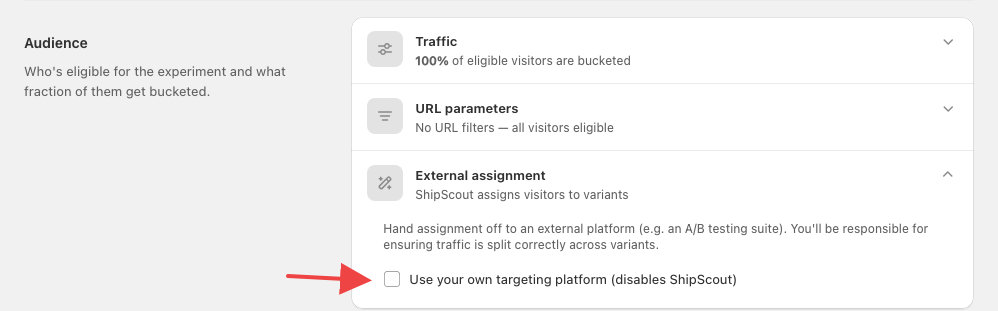
In the **Audience** section, expand the **External assignment** row and enable "Use your own targeting platform".
### Step 3 - Integrate your platform
Use the ShipScout javascript SDK to assign a variant to your visitors. For theme based shops, no pre-setup is necessary. For headless shops, you'll need to install the javascript SDK by following this guide: [Headless stores](/tasks/headless-stores.md).
Here's an example of assigning variant A to all visitors:
// Init ShipScout - this must run before you assign the variant
!function(s) { s.shipscout = s.shipscout || (e, a) => { s.shipscout._queue?.push({ type: e, ...a }); }; s.shipscout._queue = s.shipscout._queue || [];}(window)

// Assign the variant
window.shipscout("assign", {
  variantKey: "A" // all visitors will be assigned to variant A
});
Here's a more plausible example that shows how you might get an assignment from a targeting platform and map it to a ShipScout variant
```javascript
// Init ShipScout
!function(s) { s.shipscout = s.shipscout || (e, a) => { s.shipscout._queue?.push({ type: e, ...a }); }; s.shipscout._queue = s.shipscout._queue || [];}(window)
// Get assignment from you experimentation platform
const assignment = ExampleTargtingPlatform.getAssignment();
// Map assignment to ShipScout variants. ShipScout variants are always
// capital letters starting from A.
let shipScoutAssignment;
if (assignment === "12390424") {
shipScoutAssignment = "A";
} else if (assignment === "4214900") {
shipScoutAssignment = "B";
}
// Assign the variant
window.shipscout("assign", {
variantKey: shipScoutAssignment
});
```
A few things to keep in mind:
* Once a visitor is assigned to a variant, their assignment will persist for the duration of the test.
* Once a test ends, the assignment code will noop so you can clean it up at your leisure. But be sure to clean it up before you start your next experiment.
### Step 4 - Test your changes
In order to test the assignments, you will need to launch your test. Assignments will not work in draft mode.